← Back to Companion
    WhyAML Companion

    How Companion works

    What crosses the boundary, why doing this yourself does not last, how a question moves through it, and where its limits are.

    On your record

    Your question, as you typed it

    Every question lands in your compliance log like this.
    Five things on the screen, and what each one means for you.

    Five things on one screen. Watch the pointer move through them, or click a number to jump straight to one.

    The trust boundary

    The question your practitioner typed does not leave.

    Not masked. Not tokenised. Not at any stage. There is no code path that sends it - which is a different claim from “we redact before sending”, and a much easier one to hold true over time.

    Stays inside your firm
    Held on your side. Never sent.
    What your practitioner typedNever sent

    “My client Acme Ltd is a Romanian construction company and the director lives in Dubai - do I need enhanced due diligence?”

    • The question as your practitioner wrote it
    • Your client’s name and every identifying particular
    • The classification and what it found
    • The routing decision
    • Your practice and practitioner identity
    • Your compliance log
    Crosses - and only this
    What the AI model actually receives.
    What is sentNo names

    “Does a corporate client incorporated in an EU Member State, in construction, with a non-resident director in a third country, require enhanced due diligence?”

    • A redacted restatement, built inside the boundary
    • Extracts of published source material
    • The constraints the route imposes
    • Determinate values, each with its source

    The classification does not cross either. The generation layer is told what it may and may not produce. It is not told that the question was assessed as disclosing a suspicion - that is a conclusion about a named party’s conduct, and it stays on our side.

    The full data-flow position.
    Accuracy

    Numbers are looked up, not generated

    Every threshold, period and date comes from a maintained table with its provision attached. Where a value cannot be retrieved, the answer states the gap or escalates. A stated gap is recoverable; a generated number is not, because nothing about it tells you to check it.

    Why no figure is generated.
    Defensibility

    An answer from 2026 can still be defended in 2028

    Source material is held as immutable snapshots, and every answer records the version in force when it was given. Superseded snapshots are kept for as long as any log entry refers to them, so the version in your record always points at something.

    Corpus versioning and reproducibility.
    Failure mode

    It fails to a stated outcome, never a worse answer

    If classification or retrieval is unavailable, the question is refused with an explicit message and escalation is offered. Guessing a route would breach the route-up invariant in exactly the case where nothing is known about the question.

    Behaviour when a component is down.
    Your obligation

    Adopting AI is adopting new technology

    Regulation 19(4)(c) requires you to assess the risk of adopting it and record that in writing. It is the obligation most often missed - not through carelessness, but because nobody consciously decided to adopt anything. A Technological Due Diligence document is supplied for Companion.

    What goes in your Practice-Wide Risk Assessment.
    The honest objection

    You could do all of this yourself. For about a fortnight.

    None of it is technically hard. A policy on what may be asked. A standing context document. A redaction step. A log against every client. A review each time guidance moves.

    01
    The cost

    It is unbillable

    Every minute of it is overhead. It competes with client work for the attention of the person least able to spare it, and it loses that argument quietly, every time.

    02
    The effort

    It is continuous

    Not a project with an end. A discipline applied to every question, by every person, indefinitely. A deadline lands, somebody skips the log, and nothing happens - which is precisely the problem.

    03
    The risk

    It decays invisibly

    Controls that depend on sustained manual effort do not fail loudly. They erode, unevenly, and stay eroded until something is audited. By then the question is how many months are missing.

    None of this is expensive to prevent. All of it is expensive to repair - and parts of it cannot be repaired at any price.

    How it works

    Ask it the way you’d ask a colleague

    No prompt discipline to learn and no new system to adopt. Companion sits inside the practice portal you already use for verification and payment.

    01

    Ask in your own words

    In the portal, against a client or matter where there is one. No special phrasing required.

    02

    It is classified

    Type and signals, before anything is composed. Identifying detail is removed before the question travels.

    03

    You get what the route permits

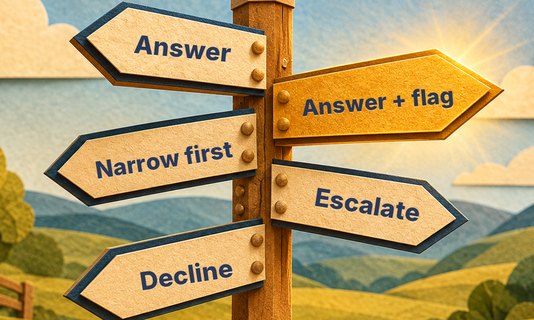
    An answer, an answer with a flag, a narrowing question, a route to your nominated officer, or a decline with where it belongs.

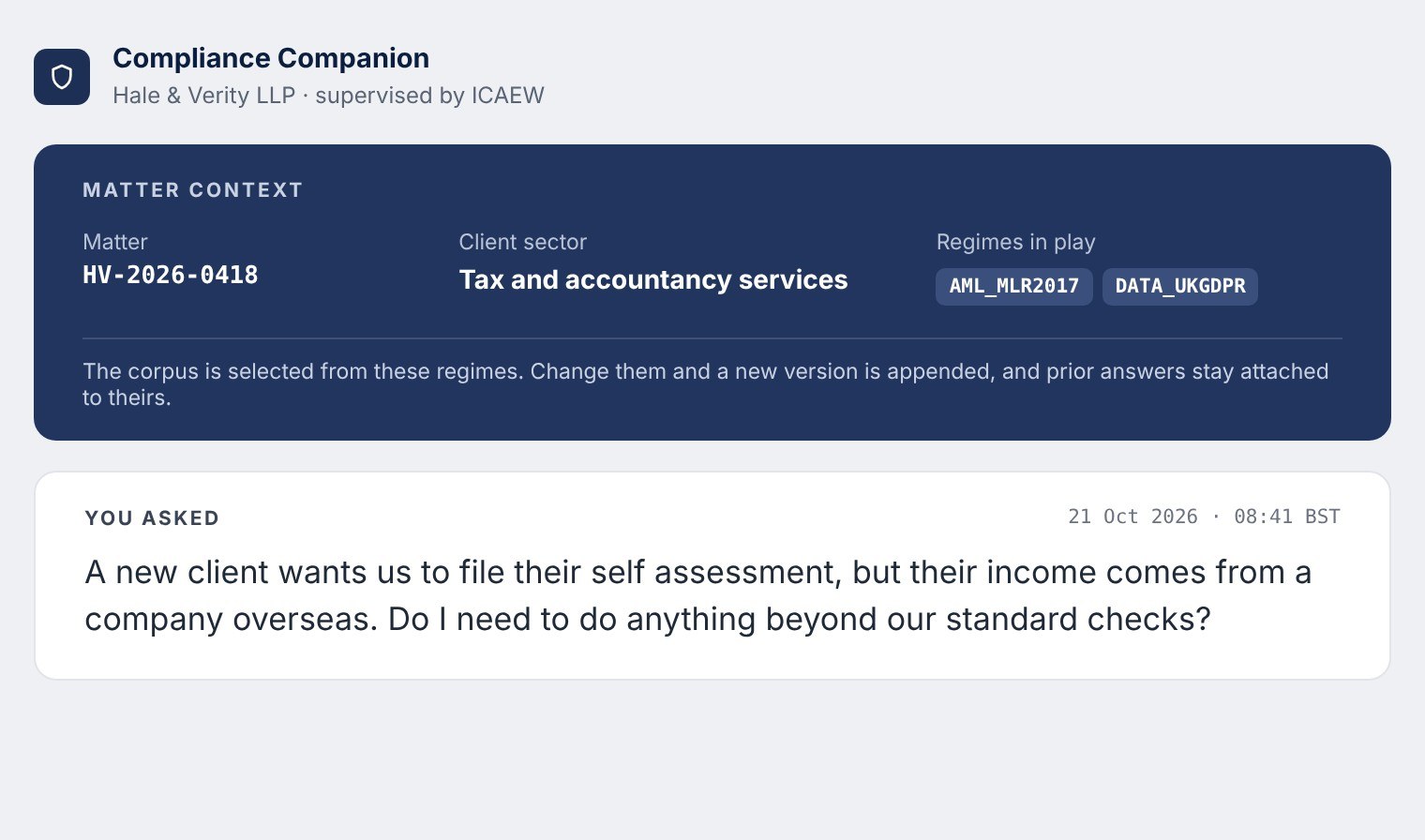
    The Companion screen: the matter context, and the question exactly as it was asked
    04

    It lands on your record

    Question, classification, response and date - filed, whether anyone remembers to log it or not.

    When a question needs a person

    Where a question needs a named professional, an escalation can be placed with an approved compliance consultant through the portal, under that consultant’s own indemnity, and billed per engagement. There is no retainer behind it.

    How escalation works, and why it is a separate boundary.
    Free to use with your credits - and why the gate is a control.
    The boundaries

    What this does not do

    A compliance service claiming no limits should be read carefully. These are the edges, stated plainly.

    01It does not give legal or regulatory advice
    What Companion doesHelps you reach your view, and records it
    What stays with your firmYour view, and the decision to act
    02It is not your nominated officer
    What Companion doesSpots when that route is needed
    What stays with your firmYour nominated officer fills the role
    03It will decline questions
    What Companion doesDeclines what it cannot properly answer
    What stays with your firmTaking it where it belongs
    04The record is evidence, not a defence
    What Companion doesA complete record of what you considered
    What stays with your firmHaving considered it properly
    The limits in full, including what is not certified.

    Start with the next question

    The lowest-risk way to evaluate this is not to change anything. Take the next compliance question that comes up - the one that would otherwise go to a chatbot, a colleague, or Tuesday’s call - and ask it in the portal instead.