Stablecoin checkout.
Built for regulated firms. Your client is verified in the same act as they pay, and the evidence lands with the money.

The tier ones are already in.



Billions have gone into rails that move stablecoin. Every one of them checks the business receiving the money, and none of them checks the person sending it.
Everything your current payment rails can't do.
Ten things this rail does that a bank transfer and a card machine cannot. All of them, on one screen.
A client without a usable bank account has no route to you at all. One holding crypto faces the off-ramp before they can pay you a penny. Paying the invoice directly bypasses all of it.
The client with no UK address historyA witnessed stablecoin payment identifies the regulated institution, the verified relationship behind the wallet, and how control was established. More source-of-funds evidence than a bank transfer provides.
How the Witness Model worksA client who trades on an exchange and transfers to their wallet produces the two strongest signals in the model: trade confirmation and exchange-to-wallet movement. The acquisition is the verification.
How the evidence is scoredNo document is sent, so no document is stored, and nothing can later leak. For a client who would rather not hand a passport to a small practice, that is the difference between engaging and not.
What is held about your clientsThe payment arrives already matched to the invoice and the client. Nothing to cross-reference, nothing to key in. That's 3.6 hours a week, and 166 hours a year, nobody was billing for.
How it reaches your ledgerAccepting stablecoin is the loudest available signal that a practice understands crypto. A genuine point of difference against other small practices.
A client can settle an invoice in stages rather than all at once, without losing the compliance evidence attached to it. Each payment is its own verification event.
How partial payments workOnce a same-chain stablecoin payment settles, it settles. No representment process, no chargeback exposure, no reserve to hold against a dispute. A materially cleaner settlement position.
Why there is no dispute windowSingle Portal Credit. One cost. Everything included.
One flat credit covers every cost of accepting the payment in full: network fees, identity verification, screening, and the compliance certificate. No transaction fee is charged, and no card-processing fee of 1.5 up to 3.5 percent applies. A practice knows the full cost of accepting a payment before it happens.
What one credit costsNo penalty for adopting early
Pricing is credit-based rather than subscription or percentage-of-volume, so there is no fee for adopting before your client base catches up. Credits stay valid 24 months. A practice that can't accept stablecoin today isn't avoiding a cost, it's staying off the rail that money is migrating toward.
Every other checkout verifies the business receiving the money.
Not one of them verifies the person sending it. So value lands from an address with no name attached, and there is nothing you could put in front of a supervisor.
We looked. Nobody else in the world does what this does.
Verifies the business.Not the person.
Verifies the person.At the source.
Your client does the work. You get paid and get the proof.

Your client is already verified.
They hold an account at a regulated institution that checked them properly, under its own legal obligations - and is supervised on whether it did. That holds even for a client with no UK address and no utility bill.

So there's nothing to collect.
No passport copy, no selfie, no scan. Your client sends no documents - to you, to WhyAML, to anyone. Nothing to chase and nothing to store.
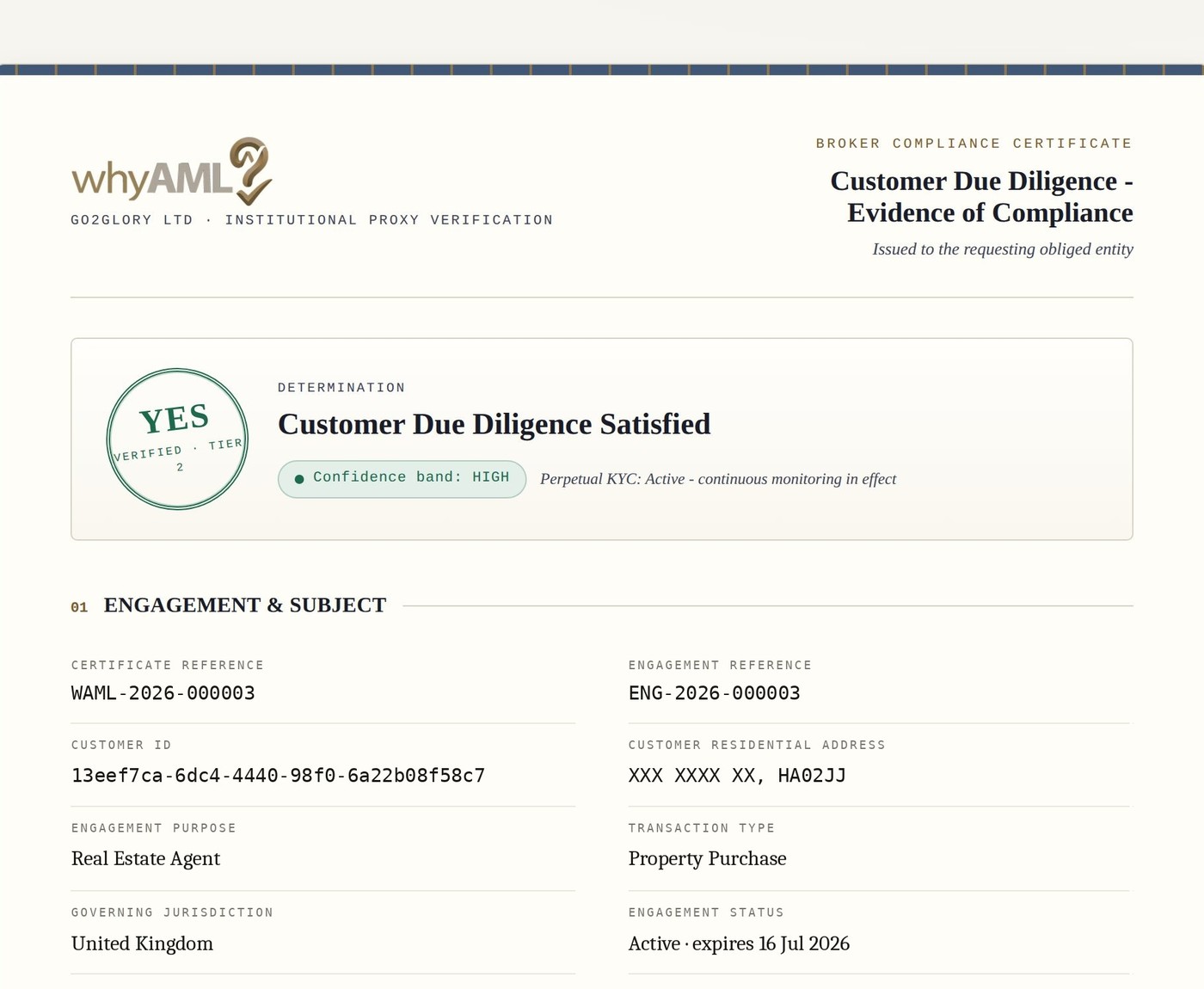
The payment is the proof.
They pay the invoice from that account. The money lands and the certificate lands, at the same moment. One act, not four steps.
One checkout. Every regulated business.
Fees paid, clients verified, one link.
Send the payment link inside the invoice you already raise. The client verifies as they pay, and the certificate lands in your file. Partial payments on the same link for staged work.
A certificate per client, a matched payment in your ledger, and nothing collected.
The certificate is yours to keep and to show HMRC. The Compliance Token belongs to the client. What never enters your practice is the passport scan, the utility bill, and the five-year retention duty that arrives with them.
Priced per check. No subscription, no minimum, no contract.
One credit covers the identity check, the screening, the certificate, your client's token, every network fee and the payment itself.
All in, for less than a biometric identity check alone.
Onboarding stalls at the document request. How Regulation 28 is satisfied without collecting anything.
Expats, overseas buyers and international tenants - verified through a regulated account they already hold.
Verification that runs in any browser, with nothing scanned, captured or stored.