The same rules as Lloyds. None of the staff.
WhyAML gives regulated firms what the big firms build for themselves: document-free ID checks, compliance-grade checkout and AI that cites its sources, on one platform.
A day, not three weeks.
Onboarding your clients actually want.
Everything a regulated firm needs to know. About the client, and about itself.
A shop needs to know very little about who pays it. A regulated firm needs to know who the client is, where their money comes from and whether they are on a sanctions list - and to show its supervisor it onboarded them properly.
Document-free ID check
- Identity verified by a certified provider, from data their own bank holds
- Screened against PEP and sanctions lists
- No passport, no selfie, nothing for you to store
Compliance-grade stablecoin checkout
- Paid from an account at a regulated institution
- The verified person is tied to the payment itself
- The compliance certificate lands with the money
Compliance-grade AI
- Every client is different, so ask in your own words
- Answered for your sector and your supervisor
- Every exchange filed on your compliance record
Every other checkout verifies the business receiving the money.
Not one of them verifies the person sending it. So value lands from an address with no name attached, and there is nothing you could put in front of a supervisor.
We verify the person, from data their own bank already holds, and screen them against PEP and sanctions lists before the money lands. No passport, no selfie, nothing for you to store.
We looked. Nobody else in the world does what this does.
Verifies the business.Not the person.
Verifies the person.At the source.
Your client does the work. You get paid and get the proof.

Your client is already verified.
They hold an account at a regulated institution that checked them properly, under its own legal obligations - and is supervised on whether it did. That holds even for a client with no UK address and no utility bill.

So there's nothing to collect.
No passport copy, no selfie, no scan. Your client sends no documents - to you, to WhyAML, to anyone. Nothing to chase and nothing to store.
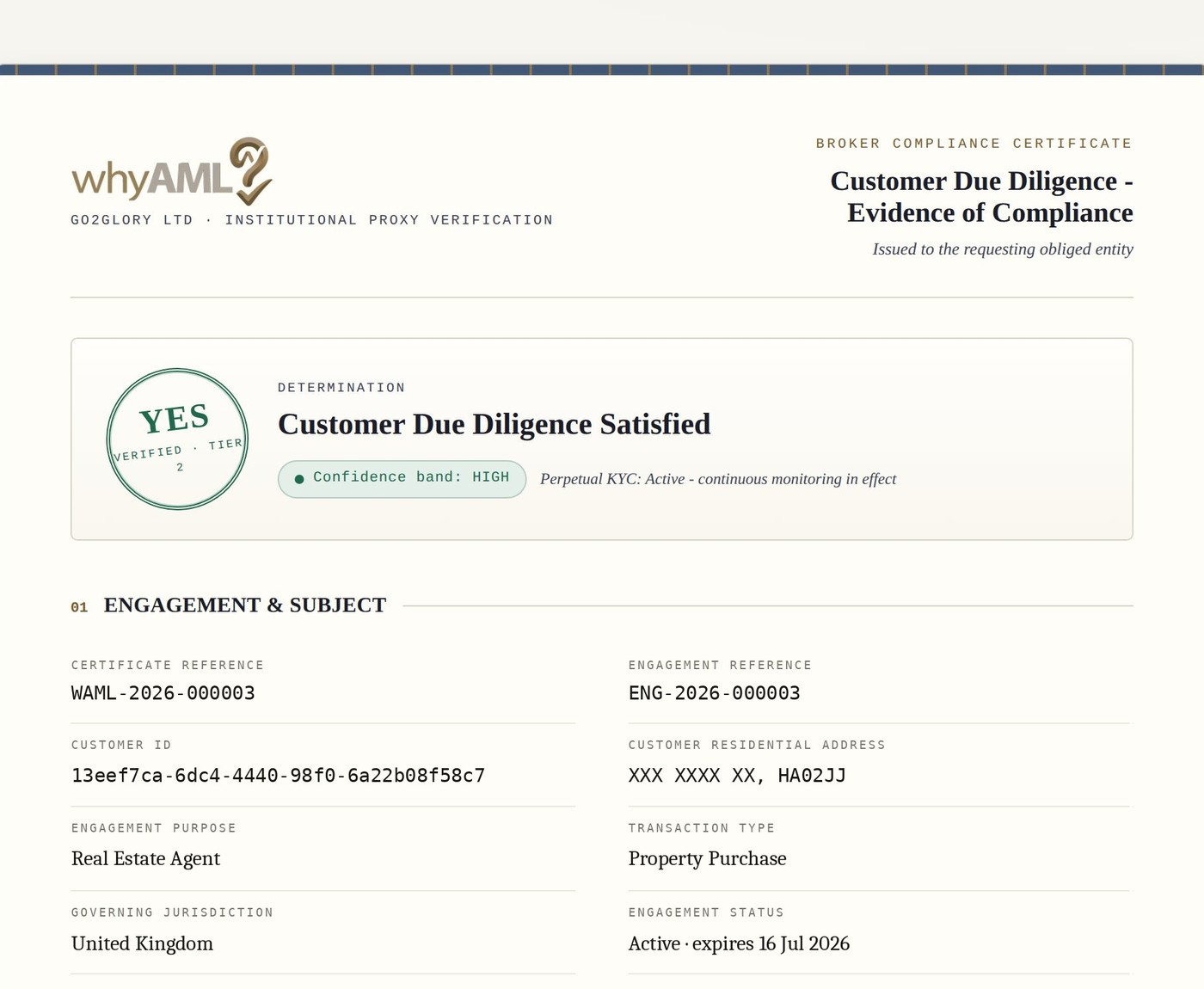
The payment is the proof.
They pay the invoice from that account. The money lands and the certificate lands, at the same moment. One act, not four steps.
Watch what your client sees, or find out what your team can ask.
Everything your current payment rails can't do.
Ten things this rail does that a bank transfer and a card machine cannot. All of them, on one screen.
A client without a usable bank account has no route to you at all. One holding crypto faces the off-ramp before they can pay you a penny. Paying the invoice directly bypasses all of it.
The client with no UK address historyA witnessed stablecoin payment identifies the regulated institution, the verified relationship behind the wallet, and how control was established. More source-of-funds evidence than a bank transfer provides.
How the Witness Model worksA client who trades on an exchange and transfers to their wallet produces the two strongest signals in the model: trade confirmation and exchange-to-wallet movement. The acquisition is the verification.
How the evidence is scoredNo document is sent, so no document is stored, and nothing can later leak. For a client who would rather not hand a passport to a small practice, that is the difference between engaging and not.
What is held about your clientsThe payment arrives already matched to the invoice and the client. Nothing to cross-reference, nothing to key in. That's 3.6 hours a week, and 166 hours a year, nobody was billing for.
How it reaches your ledgerAccepting stablecoin is the loudest available signal that a practice understands crypto. A genuine point of difference against other small practices.
A client can settle an invoice in stages rather than all at once, without losing the compliance evidence attached to it. Each payment is its own verification event.
How partial payments workOnce a same-chain stablecoin payment settles, it settles. No representment process, no chargeback exposure, no reserve to hold against a dispute. A materially cleaner settlement position.
Why there is no dispute windowSingle Portal Credit. One cost. Everything included.
One flat credit covers every cost of accepting the payment in full: network fees, identity verification, screening, and the compliance certificate. No transaction fee is charged, and no card-processing fee of 1.5 up to 3.5 percent applies. A practice knows the full cost of accepting a payment before it happens. A practice that can't accept stablecoin today isn't avoiding a cost, it's staying off the rail that money is migrating toward.
What one credit costsYour credits now answer questions, not just verify clients
WhyAML Companion sits inside the same portal. A practitioner asks a compliance question in their own words and gets an answer pitched at your sector and your supervisor, with the whole exchange written to your compliance record. Free to use with your credits.
What Companion doesOne checkout. Every regulated business.
Fees paid, clients verified, one link.
Send the payment link inside the invoice you already raise. The client verifies as they pay, and the certificate lands in your file. Partial payments on the same link for staged work.
A certificate per client, a matched payment in your ledger, and nothing collected.
The certificate is yours to keep and to show HMRC. The Compliance Token belongs to the client. What never enters your practice is the passport scan, the utility bill, and the five-year retention duty that arrives with them. And the compliance questions your people are already asking somewhere else get asked in the portal instead, on your record.
Your compliance questions, answered and on record.
Your people are already asking AI. Companion knows your firm, checks the question before it answers, and files every exchange on your record.
Free to use with your credits.Priced per check. No subscription, no minimum, no contract.
One credit covers the identity check, the screening, the certificate, your client's token, every network fee and the payment itself.
All in, for less than a biometric identity check alone.
Onboarding stalls at the document request. How Regulation 28 is satisfied without collecting anything.
Expats, overseas buyers and international tenants - verified through a regulated account they already hold.
Verification that runs in any browser, with nothing scanned, captured or stored.